

Why does your most expensive gear feel like a sodden weighted vest after just three kilometers in the tropical heat? You’ve likely felt the frustration of technical fabrics that promise moisture management but ultimately fail under the weight of ninety percent humidity. It starts with a slight cling, then the fabric saturates, and suddenly you’re fighting your clothes instead of the road. Finding the right running apparel for humidity is not just about moving sweat; it's about managing the weight of water.
We agree that elite performance shouldn't be hampered by heavy, water-logged gear or the sting of severe chafing. This guide promises to help you master the science of tropical moisture management. You’ll learn how to curate a premium running kit that stays light, dry, and fast in the most punishing climates. We will explore the technical difference between wicking and evaporation, and show you how to build a rotation of high-performance gear from brands like Tracksmith and Satisfy that feels truly invisible.
Key Takeaways
- Master the physics of the "evaporation gap" to understand why standard fabrics fail when moisture levels peak.
- Learn how to evaluate running apparel for humidity by prioritizing high-gauge knit structures that eliminate the "cling factor."
- Curate a performance-driven kit using singlets and technical shorts designed to minimize friction and maximize airflow.
- Implement essential maintenance routines like immediate rinsing and cold washing to preserve the elasticity of your premium gear.
- Gain insights into the KITAthletic philosophy of selecting specialized equipment that supports your dedication to movement.
The Physics of Tropical Running: Why Standard Gear Fails in Humidity
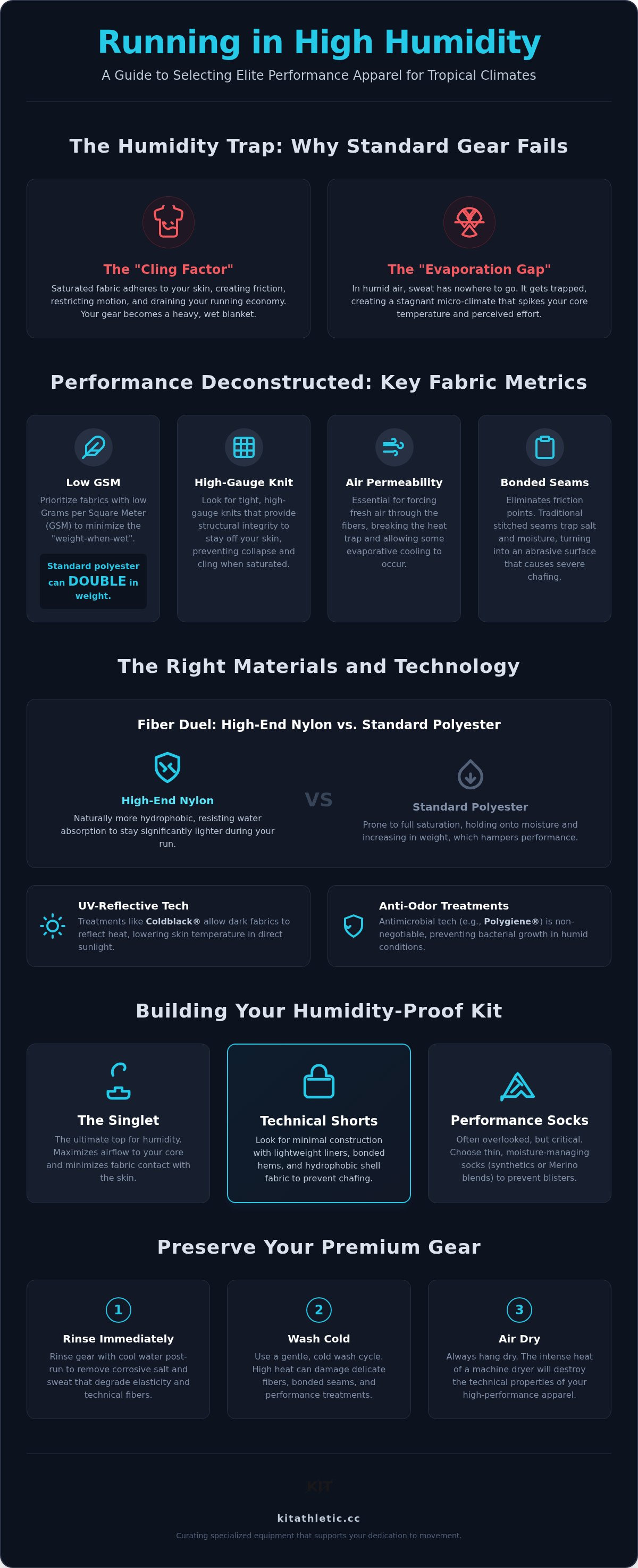
High humidity changes the rules of thermoregulation. Most gear is tested in labs with low moisture, but tropical environments present a unique challenge. When you're running through air that's already saturated, your sweat has nowhere to go. This creates the "Evaporation Gap," a state where the air's moisture content is so high that it can no longer absorb the vapor from your skin. Standard gear simply holds onto that moisture, turning your kit into a heavy, wet blanket.
This leads to the "Cling Factor." When fabric saturates, it adheres to your skin, creating friction and restricting your natural range of motion. This isn't just uncomfortable; it's a drain on your running economy. You're effectively fighting the weight and resistance of your own clothes with every stride. Instead of focusing on your form, you're managing the distraction of wet fabric dragging against your muscles.
True technical fabrics go beyond simple moisture wicking. While wicking merely moves sweat from the skin to the outer layer, effective running apparel for humidity focuses on comprehensive moisture management. This means reducing the "weight-when-wet" and maintaining air permeability even when the fibers are drenched. The primary enemy is fabric saturation, which blocks the airflow needed to cool your core and causes the garment to lose its shape.
Vapor Pressure and Your Skin
Humidity creates a stagnant micro-climate between your skin and your shirt. Without high air permeability to force fresh air through the fibers, this layer becomes a heat trap that spikes your perceived exertion. Vapor pressure is the physical force exerted by water molecules in the air that dictates whether your sweat will evaporate into the atmosphere or remain trapped against your body. High-performance gear must overcome this pressure to keep you moving comfortably.
The Weight of Water: Why GSM Matters
Standard polyester is a trap in the tropics because it can double in weight when fully saturated. This is why we look at GSM (grams per square meter) as a critical metric. Lower GSM fabrics, like those found in the Tracksmith Strata or Satisfy Justice collections, minimize the amount of water the garment can physically hold. A shorter dry-down time is essential for maintaining speed. If your kit stays heavy for the duration of your run, you're carrying unnecessary baggage that slows your pace and kills your momentum.
How to Evaluate Technical Fabrics for Humidity Performance
Selecting the right running apparel for humidity requires a shift in focus from aesthetics to engineering. You need fabrics that act as a high-performance interface between your body and the environment. Start by examining the knit structure. High-gauge knits are essential because they provide enough structural integrity to stay off your skin, even when the air is thick with moisture. This prevents the fabric from collapsing and creating that restrictive, water-logged sensation.
Next, look for UV-reflective treatments such as Coldblack. This technology is a game-changer for runs in direct sunlight. It allows dark fabrics to reflect heat rather than absorb it, significantly lowering your skin temperature. You should also prioritize bonded seams over traditional stitching. Stitched seams are notorious for trapping salt and moisture, which quickly turns into an abrasive surface against your skin. Bonded construction eliminates these friction points, ensuring a "zero-distraction" experience during long efforts.
Finally, consider the fiber blend. While pure synthetics are the industry standard, high-performance Merino blends offer surprising benefits in the tropics. They manage vapor exceptionally well, often feeling drier against the skin than basic polyester alternatives. For those seeking the pinnacle of curation, you can browse the technical selection at KITAthletic to find gear that meets these rigorous standards.
Synthetic Excellence: Nylon vs. Polyester
High-end Nylon, like the Justice fabric utilized by Satisfy, often outperforms polyester in extreme humidity. It is naturally more hydrophobic, meaning it resists water absorption and stays lighter during your run. Many premium garments also feature laser-cut micro-perforations in high-sweat zones to maximize airflow. To ensure these technical features work effectively, your gear must fit perfectly. Consult the Tracksmith sizing guide to find a silhouette that balances aerodynamics with ventilation.
The Role of Anti-Odor Technology
Humidity is the primary catalyst for bacterial growth in athletic wear. This is why antimicrobial treatments like silver ions or Polygiene are non-negotiable for a daily training rotation. These technologies work by breaking down odor-causing bacteria before they can bond with the fibers. In a tropical climate, this doesn't just keep your kit smelling fresh; it preserves the lifespan of the fabric by preventing the buildup of acidic sweat residues that degrade technical yarns over time.
Building Your Humidity-Proof Kit: From Singlets to Technical Socks
Building a kit that performs in ninety percent humidity requires a departure from standard training gear. Every layer must serve a purpose, prioritizing air permeability over mere aesthetics. The singlet is the undisputed gold standard for running apparel for humidity. By exposing the shoulders and underarms, you facilitate the body's natural cooling process through convection, even when evaporation is stalled. Look for silhouettes that offer a relaxed fit to prevent the fabric from clinging to your torso as you sweat.
Your choice of shorts is equally critical for managing high-friction areas. For maximum airflow, the three-inch split short is the traditional choice, allowing the legs to move without resistance. However, if you're prone to chafing in the heat, high-performance half-tights provide a compressive barrier that stays in place. The goal is to find a liner that supports without retaining excess heat, ensuring you stay focused on your pace rather than skin irritation.
Don't neglect your extremities. Technical socks made from moisture-expelling fibers are essential to prevent "swamp foot" and the blisters that follow. These socks use specialized knit patterns to move liquid away from the skin and out toward the shoe's upper. Finally, consider your eyewear strategy. In high humidity, lens fogging is a constant threat. Choose frames with ventilated bridges and anti-fog coatings to maintain clarity when the air is thick.
The Upper Body: Singlets and Mesh
Prioritize airflow over coverage. Racing singlets with open-mesh structures offer the most efficient path for heat to escape your core. Fabrics like the Justice technology found in Satisfy gear provide a unique, silk-like feel that resists saturation and never sticks to the skin. This technical intentionality ensures that your upper body remains light and dry, even during the most punishing tropical sessions.
The Lower Body: Managing Friction
Focus on waistbands that use wide, perforated elastic to distribute pressure and wick moisture away from your midsection. A saturated waistband is a common source of discomfort that many athletes overlook. To complete your high-performance setup, integrate specialized accessories like District Vision eyewear Indonesia. These tools are designed to handle the specific environmental stressors of the region, ensuring your vision remains as sharp as your kit.
How to Maintain Your Performance Gear for Long-Term Functionality
Investing in premium running apparel for humidity is a commitment to your performance. However, the tropical environment is as harsh on fabrics as it is on the athlete. High humidity and intense sweat sessions lead to significant salt accumulation within technical fibers. If left to dry, these salt crystals harden and act like microscopic sandpaper, abrading the yarns from the inside out with every movement. To preserve the integrity of your gear, you must adopt a rigorous maintenance protocol.
The first rule is the cold wash. High temperatures are the enemy of technical bonding and elastane. Hot water can melt the adhesives used in bonded seams and degrade the elasticity that provides your gear's shape and support. Similarly, choosing the right detergent is vital. Standard grocery store brands often contain optical brighteners and heavy fragrances that leave a residue. Opt for a specialized 'Sport Wash' designed to break down oils and bacteria without clogging the technical pores of the fabric.
Always air dry your equipment. The high-heat cycle of a dryer is a gear killer that can permanently damage UV-reflective treatments and silver-ion antimicrobial coatings. By following these steps, you ensure that your investment continues to perform at its peak. You can explore the latest arrivals at KITAthletic to find gear built to withstand these demanding conditions.
The Immediate Post-Run Protocol
- Rinse: Immediately after your run, rinse your kit in cold, fresh water to flush out salt and acids.
- Squeeze: Gently squeeze out excess water. Never wring or twist the fabric, as this can snap delicate technical fibers.
- Hang: Place the garment on a hanger in a well-ventilated area away from direct sunlight.
In high-humidity environments, drying can be slow. To prevent odor buildup during the drying process, ensure there is active airflow, such as a fan, to move moisture away from the fabric quickly. This prevents bacteria from colonizing the damp fibers before they dry completely.
What to Avoid: The Technical Gear Killers
Fabric softeners are perhaps the most damaging substance for high-performance apparel. They work by coating fibers in a waxy film to make them feel soft, but this film effectively seals the pores of moisture-wicking fabrics. Once coated, your shirt will no longer manage sweat effectively, regardless of its original technical specifications. You should also avoid drying your gear in direct, harsh sunlight. Intense UV exposure can cause certain technical elastomers to become brittle and lose their stretch over time. The longevity of your kit is the true measure of its value; meticulous care transforms a high-end purchase into a sustainable investment in your performance.
Elevating the Movement: The KITAthletic Approach to Curation
KITAthletic stands as the national hub for athletes who refuse to compromise on their equipment. We act as a discerning filter, selecting only the most effective global brands to meet the specific needs of the Indonesian runner. Our mission is to provide running apparel for humidity that performs under the most punishing environmental stressors. This isn't just retail; it's a curated selection process driven by technical intentionality. We understand that every kilometer in a tropical climate requires gear that manages moisture with surgical precision.
Our philosophy, "For the Sake of Movement," dictates every addition to our collection. We prioritize tools that disappear during use, allowing you to focus entirely on your pace and form. By focusing on high-end aesthetics paired with peak functionality, we bridge the gap between elite performance and personal lifestyle. We believe that the right equipment acts as a catalyst for dedication, turning every training session into an opportunity for excellence. We invite you to join a community that views movement as a fundamental expression of purpose.
Curated for the Tropical Athlete
Our selection of Tracksmith and Satisfy is specifically tailored for high-humidity performance. These brands utilize advanced textiles like Strata and Justice fabrics to ensure you stay light and dry when the air is thick. Performance extends beyond what you wear; it includes how you fuel. Integrating Maurten nutrition Indonesia into your rotation is essential for maintaining energy levels during humid races where traditional gels might fail. This holistic approach to gear and nutrition supports the psychological optimism required to push through the hardest segments of your run.
Your Next Step in the Movement
Transitioning from casual gear to technical tools is a pivotal moment in an athlete's journey. It marks a shift from simply "going for a run" to training with intent. We encourage you to explore our full curation of precision-engineered apparel for your next endurance challenge. Whether you're preparing for a marathon or a daily speed session, our equipment is designed to support your pursuit of speed. Empower your performance with gear that respects the science of movement and the reality of the tropics. Explore the collection today and redefine what it means to run fast in the heat.
Master the Tropical Elements
Mastering your environment starts with understanding the physics of the tropics. You now know that standard gear fails when the evaporation gap closes; making the right running apparel for humidity a vital tool for elite performance. By prioritizing low-GSM fabrics and bonded construction, you eliminate the weight and friction that stall your progress. Maintaining these technical assets through immediate rinsing and air-drying ensures your kit remains effective for every training block.
As the official Indonesia partner for Tracksmith and Satisfy, KITAthletic provides a selection tested in peak tropical humidity. We offer premium technical support to help you find the perfect fit for your specific movement needs. Shop the Curated Collection for Tropical Performance at KITAthletic to upgrade your rotation with precision-engineered tools. Elevate your dedication and let your gear work as hard as you do. The road ahead is yours to conquer.
Frequently Asked Questions
What is the best fabric for running in high humidity?
High-gauge synthetic knits and hydrophobic nylons are the most effective choices for tropical conditions. Fabrics like Tracksmith’s Strata or Satisfy’s Justice are engineered to maintain their structure even when fully saturated. They offer superior air permeability, which is vital when the air is too thick for natural evaporation. Unlike basic polyester, these specialized textiles stay off the skin and prevent the restrictive cling that ruins your running economy.
Should I wear loose or tight clothing for humid runs?
A slightly relaxed fit is generally superior for the upper body to promote convection and airflow. For the lower body, many elite runners choose tight technical half-tights to eliminate the skin-on-skin friction that causes chafing. The goal is selecting running apparel for humidity that doesn't collapse against your skin when wet. Your kit should provide enough space for air to circulate while offering support in high-friction zones.
How do I prevent my running clothes from smelling after humid sessions?
Choose gear treated with antimicrobial technologies like silver ions or Polygiene to inhibit bacterial growth. You must rinse your clothes in fresh water immediately after every run to flush out the salts and organic matter that bacteria feed on. Never leave damp gear in a laundry basket. In tropical climates, ensuring active airflow during the drying process is essential to prevent deep-seated odors from developing within the technical fibers.
Is cotton or polyester better for running in hot and humid weather?
Technical polyester and advanced synthetic blends are always better than cotton. Cotton is a hydrophilic fiber that can absorb up to twenty-five times its weight in water, making it heavy and abrasive during a run. Modern synthetics are hydrophobic by design. They move moisture to the surface and dry significantly faster, keeping your kit light and functional even when the relative humidity exceeds eighty percent.
Why does my running gear feel heavier halfway through my run?
Your gear feels heavier because it has reached its saturation point and is physically holding onto your sweat. When high humidity prevents evaporation, the fabric acts as a reservoir for moisture instead of releasing it. Standard technical shirts can double in weight when they are fully drenched. Selecting apparel with a low GSM ensures that even at total saturation, the weight remains manageable for high-performance efforts.
How can I prevent chafing when running in tropical climates?
Prevent chafing by switching to apparel with bonded seams and using high-quality anti-chafe balms on friction points. Stitched seams become abrasive once they are saturated with salt crystals. Technical half-tights or split shorts with integrated liners provide a smooth barrier that protects the skin. Proper fit is also vital; loose, wet fabric moving repeatedly against your skin is the primary cause of severe tropical skin irritation.
Do I need special socks for running in humidity?
Yes, technical socks made from moisture-expelling synthetic blends are essential to prevent blisters and "swamp foot." Look for socks with dedicated ventilation zones on the bridge of the foot to allow heat to escape. Avoid cotton socks entirely because they saturate quickly and lose their shape. High-performance socks from brands like Fingerscrossed use specialized yarns that keep your feet dry and secure inside your shoes during long efforts.
Can I use regular laundry detergent for technical running apparel?
No, you should avoid regular detergents and fabric softeners for your high-performance kit. Standard detergents often leave waxy residues that clog the technical pores of the fabric, which ruins the moisture-wicking properties over time. Use a specialized "Sport Wash" formulated to remove oils and bacteria without damaging technical coatings. This care routine preserves the lifespan and performance of your running apparel for humidity.